Noize toyz
I see this feed as a good opportunity to indulge in anything design/build-adjacent; anything that mashes an interest I have through a design or code filter. Playing with synths, sound manipulation and general audio-play (I’d hesitate to call it music) is a hobby, and I like to listen to ambient music when I’m working, so there's a particular kind of magic in a sound workflow that takes three seconds of a field recording and stretches it into a ten-minute, cathedral-reverb-soaked piece of (accidentally grand) sound. That's Paulstretching; an extreme time-stretching algorithm, beloved by ambient producers and sound designers for turning anything into slow, glassy, choir-like drone.
I've wanted a version I could just reach for — no install, no DAW, no plugin folder. Drop a sound in, pull a fader, hear it dissolve. So I built one.
What PaulStretch actually does
Most time-stretchers try to preserve the sound; Paulstretching does the opposite. It slides a window across the audio, and for each little slice it keeps the frequencies but throws away the timing – randomizing the phase before stitching everything back together. The resulting sound is smeared into a texture, all attack gone, pure harmonic, cinematic noise wash. For a time-poor person wanting something to build on for ambient or techno tracks, it’s a slate from which to build.
Two knobs do most of the work:
Stretch — how far you pull time apart. 8× is a nice ambient starting point; 50× is a drone from a single chord.
Window — how much smearing. Small windows keep some grit; large ones melt everything into glass.
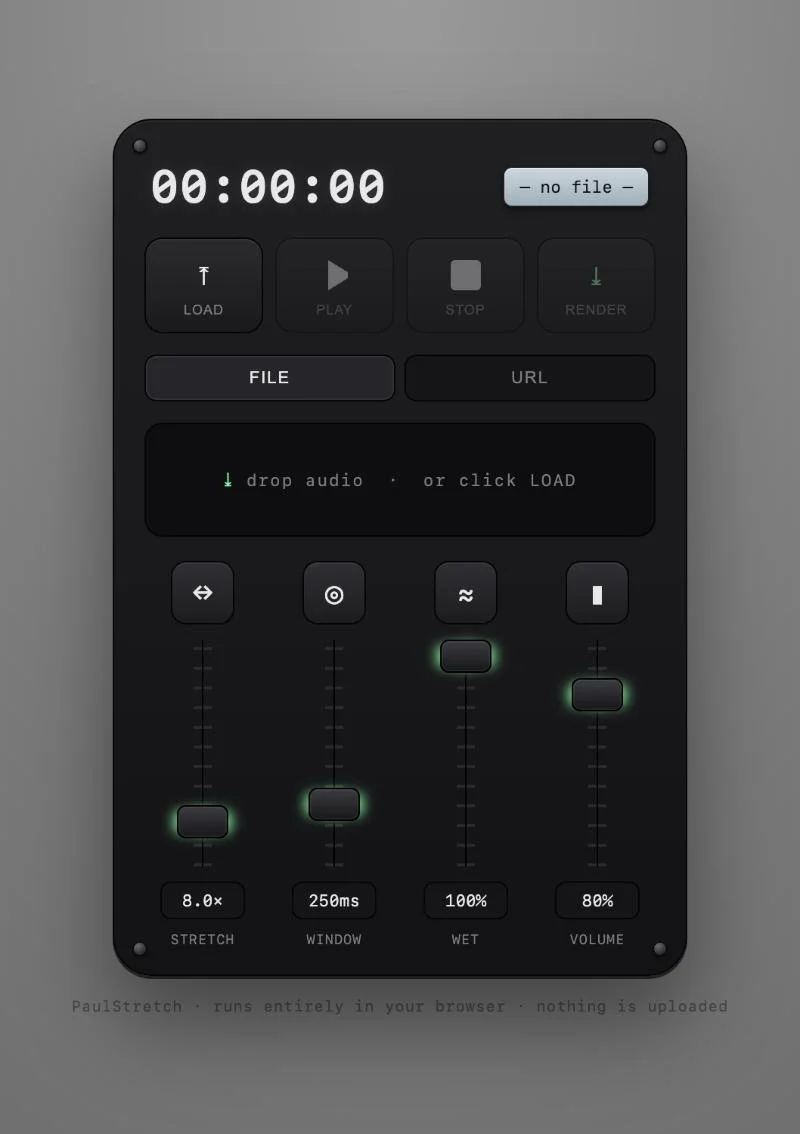
Designing it like a digital device, without the fake screws and skeumorphism
I’m a basic design bod. I'm drawn to the tactile, minimalist, Dieter Rams-inspired look of audio like Teenage Engineering's OP-1, and the practical of Digital Audio Workstations (DAWs) like Ableton Live. So instead of a flat web form, I built the interface as a digital device: a dark screwed-down panel, a segment clock, VU meters, and four physical-feeling faders. Drag and drop your sound, tweak the parameters, and download enjoy the algorithm’s output.
The whole thing runs entirely in the browser. The stretching happens live in JavaScript (an FFT, phase randomisation, overlap-add resynthesis), and you can export the result.
Try it
https://paulstretch-web.vercel.app/
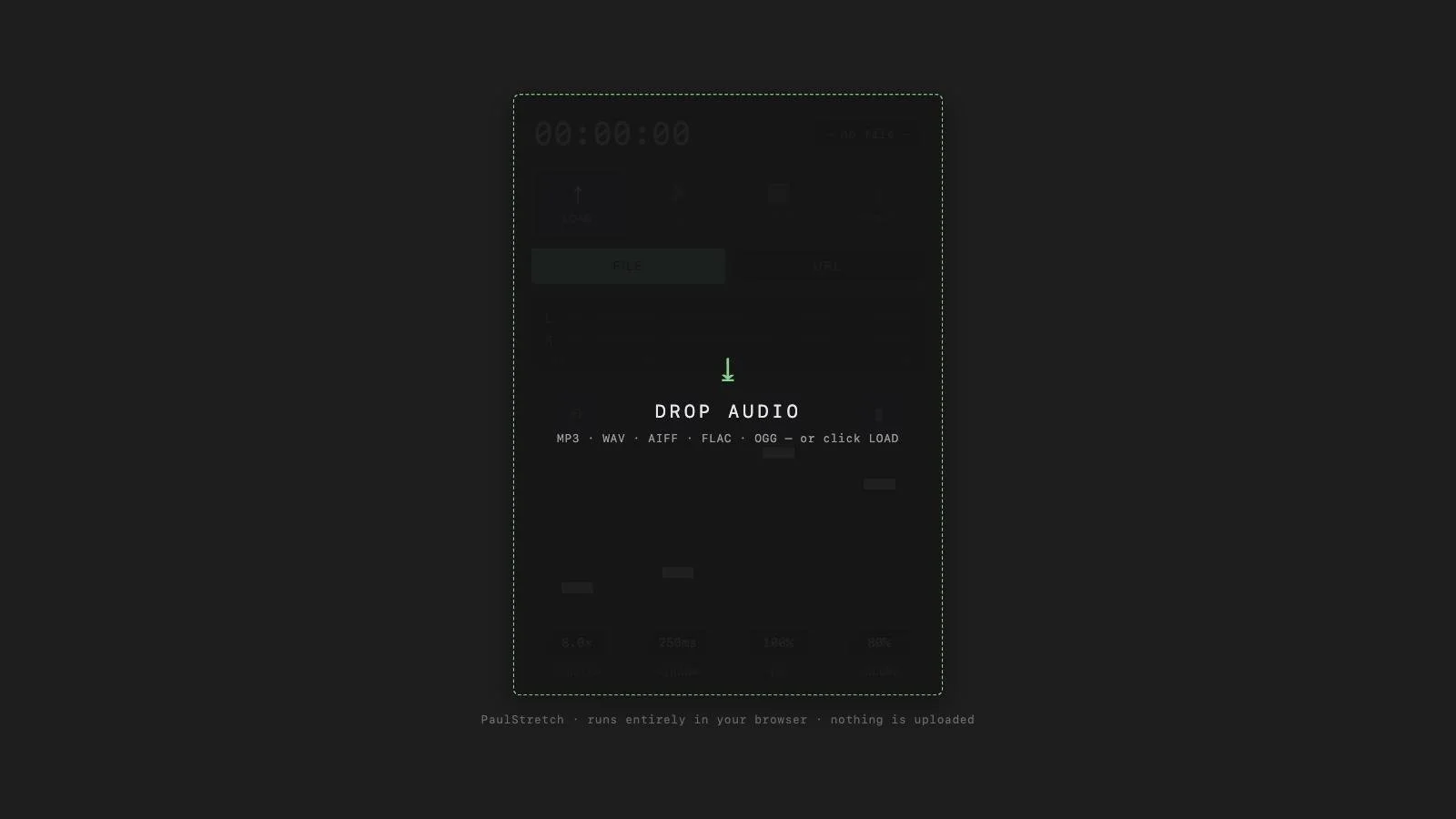
Drop in an MP3, WAV, or AIFF and pull the Stretch fader. Voice notes, a single piano note, a rain recording, a synth pad – anything with harmonic content turns into something you could happily work away to in the background.
The code is available here on my GitHub repo.
What's next
I’m adding dry/wet blend, maybe a built-in reverb tail, and – backend and legality-permitting – perhaps pasting a YouTube URL straight in. For now it's the simple sound toy I wanted to help generate sound sketches and build music ideas from, and another example of LLM-powered coding tools being the enabler for long-dormant ideas.
